

Showing posts with label citadel. Show all posts
Showing posts with label citadel. Show all posts
08 November 2013
"Best Local Conspiracy Theory"
The Coast's Best of Halifax 2013 is out, and among the many gold winners is the maze of tunnels that are alleged to connect Citadel Hill and Georges' Island. The debunked passageway to the harbour island won "Best Local Conspiracy Theory", ahead of Bayers Lake's Holy Grail and a clean harbour. The Coast was nice enough to recommend this blog for more information on the tunnels.

11 January 2011
Downtown Halifax Tunnels

Photo: National Resources Canada
For decades construction crews have been bumping into passageways beneath Halifax's downtown core. The tunnels under Halifax have been written about and discussed for decades. The official line was that they were not actually passageways, but sewers.They're definitely not sewers.
Photographs taken in 1976 show rock walls with arched ceilings, approximately six feet high, and wooden floors.
Rumours suggest that many of the older buildings that did, and still do, stand downtown could access these tunnels from their basement level.
We know there are, or were prior to development, stone passageways under many streets in the core. What we can't seem to agree on, or confirm true, is the existence of other tunnels branching out from the downtown. Some believe a tunnel connects Brunswick Street to the Halifax Citadel. Others suggest a tunnel connects the Halifax Citadel to the Halifax Armoury at the corner of North Park and Cunard Street. Both make sense, but I have yet to encounter anyone who can confirm or deny they're actually there.
Then there is the tunnel that allegedly runs from somewhere near the harbour, presumably near Sackville at Lower Water Street, and then beneath the harbour floor, eventually surfacing on the once militarized George's Island.
The George's Island under-water passage has been debunked but some of the mystery still remains in the words of 19th century mason John William Cameron. Cameron, although sworn to secrecy, claimed to have built two tunnels under Halifax- the tunnel to the Citadel as well as the tunnel to the island.
Over time I've built a map to illustrate where the tunnels might potentially lie. To my knowledge, only a few of them are at all accessible.
View Downtown Halifax Tunnel System in a larger map.
Confirmed (Blue Marker) ― These are documented tunnel entrances, some verified by photo. | Date | Entrance Location |
| 2012 | 1682 Hollis St (Halifax Club) |
| 1995 | Sackville St at Lower Water St |
| 1977 | Duke St at Granville St |
| 1976 | Price St at Grafton St |
| 1973 | George St |
| 1938 | Duke St at Market St |
| 1919 | Town Clock |
Rumoured (Yellow Marker) ― These tunnel entrances range from speculative to debunked.
| Date | Entrance Location |
| 1995 | Prince St at Market St |
| - | 1740 Granviille St (Dennis Building) |
Blue Lines ― Represent tunnels that almost certainly do, or did, exist.
Red Lines ― Represent tunnels that do not exist, or are not likely to exist.
26 July 2008
Odds & Ends
I haven't posted anything in a while so I thought I'd share some of the local odds and ends photos and scans I've collected along the way.
1. Downtown Halifax, 1880s. Photo c/o Canadian Navy.

2. Downtown Halifax, 1880s. Photo c/o Canadian Navy.

3. Halifax Harbour, May 1942. Photo c/o Canadian Navy.

4. Map of Point Pleasant Park at it's entrance.

5. Undated historic map of Halifax.

6. Undated historic map of Halifax.

1. Downtown Halifax, 1880s. Photo c/o Canadian Navy.
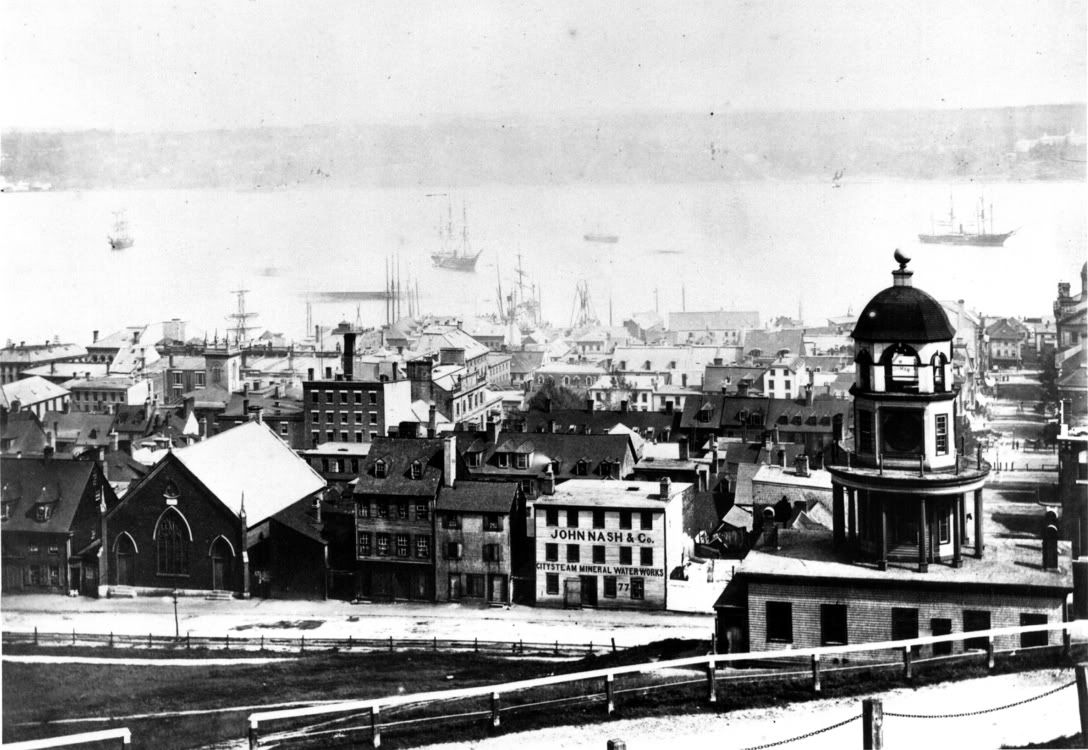
2. Downtown Halifax, 1880s. Photo c/o Canadian Navy.

3. Halifax Harbour, May 1942. Photo c/o Canadian Navy.

4. Map of Point Pleasant Park at it's entrance.

5. Undated historic map of Halifax.
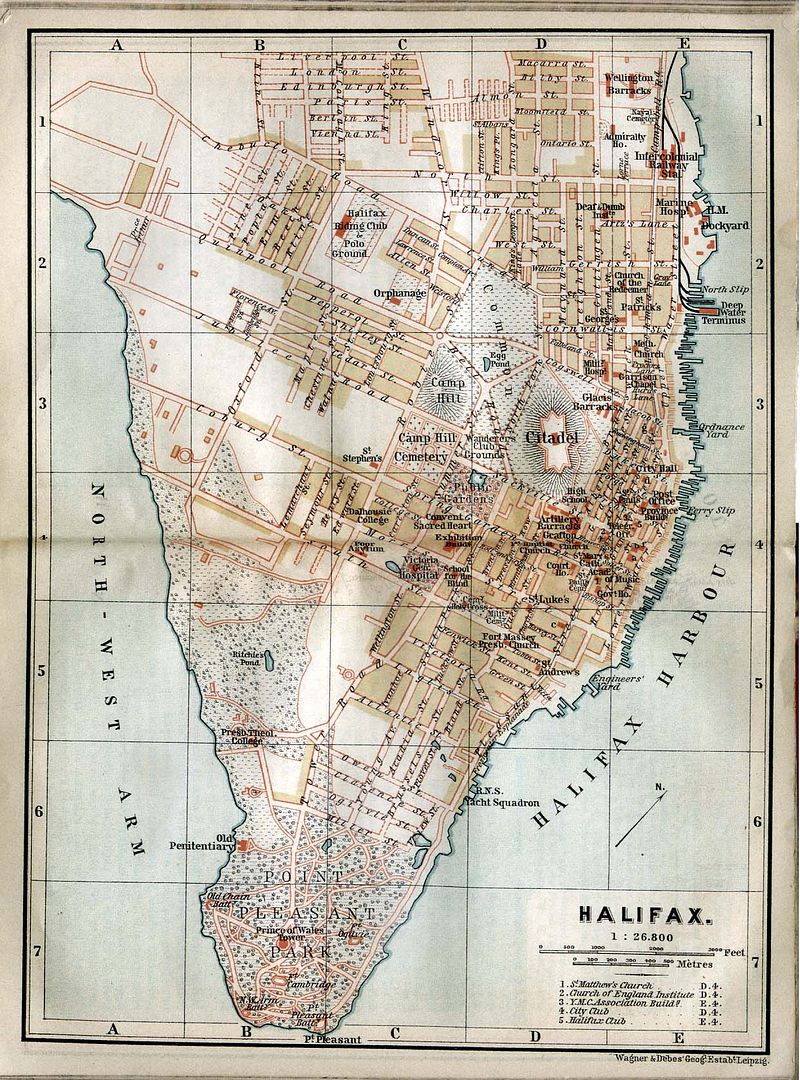
6. Undated historic map of Halifax.

16 June 2008
Exploring Georges Island
Somehow we managed to arrive in time to make our 10am ferry to Georges Island. We met our friends in the terminal and boarded a somewhat overcrowded Metro Transit ferry.
The island was great. Very well preserved considering some of the harsh weather it sees. Photo opportunities were sadly scarce though due to its temporary over-population. The island did provide some unique views of the city and I was able to take some, if nothing else, interesting shots inside, above and beneath Fort Charlotte.
Below are a handful of the pictures I was able to take during our 1h 45m trip to Georges Island
View Halifax Defence Complex in a larger map
The island was great. Very well preserved considering some of the harsh weather it sees. Photo opportunities were sadly scarce though due to its temporary over-population. The island did provide some unique views of the city and I was able to take some, if nothing else, interesting shots inside, above and beneath Fort Charlotte.
Below are a handful of the pictures I was able to take during our 1h 45m trip to Georges Island
View Halifax Defence Complex in a larger map
Subscribe to:
Comments (Atom)
